We use necessary cookies to make the site work. With your consent, we also use cookies for statistics, so we can see how the site is used and improve it, and for marketing, so we can measure and show advertisements. You can change your choice at any time via Cookie settings at the bottom of every page. Read the cookie statement
NecessaryAlways on
Needed to make the site work, such as your shopping cart and remembering this choice.
Google Analytics and similar services show us how visitors use the site, so we can improve it.
This lets us measure whether our advertisements work and show ads that match your interests, including via Google, Meta (Facebook and Instagram), LinkedIn and Microsoft.
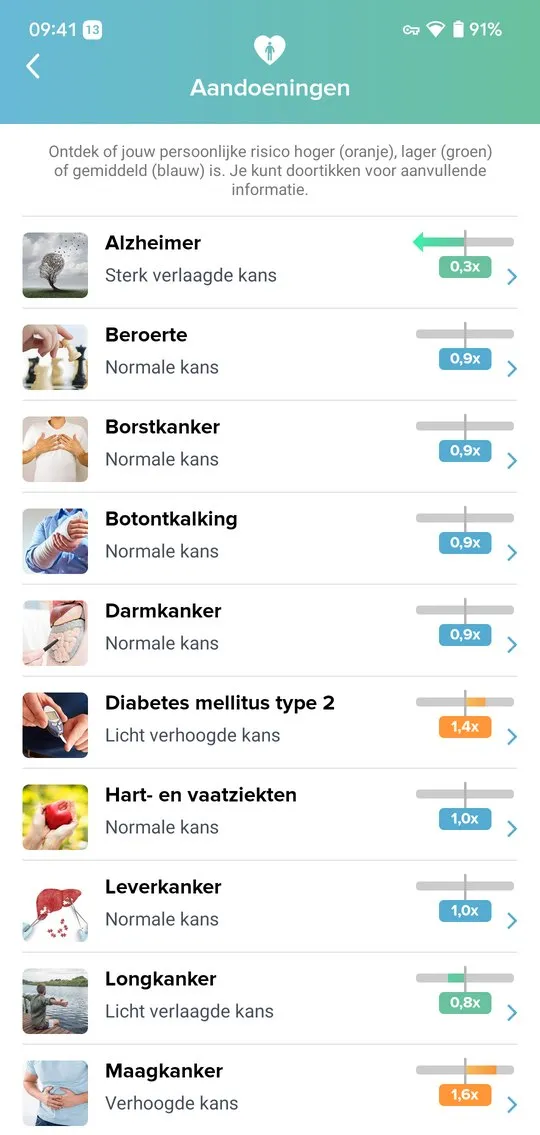
Everyone knows that living healthily pays off. But what makes the biggest difference for you? You see your predisposition to 17 conditions that you can influence yourself, and a personal list of the lifestyle choices that bring you the greatest health gains.
You get information about conditions where, from a preventive point of view, it makes sense to know your own predisposition. For example, because you can help prevent them yourself by changing your lifestyle, or by being alert to early detection.
What you get
Your predisposition per condition: an increased or, conversely, a reduced risk.
Your personal priorities: where you have the most to gain.
Always up to date: based on the latest scientific insights.
The conditions
17 conditions in four groups.
Heart, blood vessels & metabolism
Cardiovascular disease
Cardiovascular disease is a collective term for conditions of the heart and blood vessels. Coronary heart disease is the most common: conditions caused by the narrowing or blockage of the coronary arteries. Important forms are acute heart attack and angina pectoris.
What does your DNA say?
Your personal risk depends on various factors: your DNA, but also environmental factors and your lifestyle, for example. To say something about your genetic predisposition, we look at variations in your DNA.
In some families, cardiovascular disease occurs earlier and more often than in others. There are also genetic factors that only increase the risk later in life, directly or indirectly (for example through a predisposition to high blood pressure).
What can you do with your result?
You will know whether you have a genetically increased or reduced risk of cardiovascular disease. That tells you how important a healthy lifestyle is for you, especially as risk factors reinforce one another. This means you can take targeted steps to reduce your risk. In the app you can see which lifestyle advice will bring you the greatest personal health gains.
Heart, blood vessels & metabolism
Stroke
Stroke is the collective term for a cerebral infarction and a cerebral haemorrhage. During a stroke, part of the brain receives no blood. A temporary blockage of a blood vessel is called a TIA. A cerebral haemorrhage is caused by a small tear in a blood vessel, usually at a weak spot (aneurysm).
What does your DNA say?
Your personal risk depends on various factors: your DNA, but also environmental factors and your lifestyle, for example. To say something about your genetic predisposition, we look at variations in your DNA.
What can you do with your result?
You will know whether you have a genetically increased risk of stroke. That tells you how important it is for you to keep an eye on your blood pressure: almost 40% of strokes are caused by high blood pressure. This means you can take targeted steps to reduce your risk. In the app you can see which lifestyle advice will bring you the greatest personal health gains.
Heart, blood vessels & metabolism
Type 2 diabetes
Type 2 diabetes develops when the body can no longer regulate blood sugar properly: it no longer responds well to insulin, the hormone that ensures sugars are taken up by the body's cells. Younger people are also developing the disease more and more often.
What does your DNA say?
Your personal risk depends on your DNA, but to a large extent also on environmental factors and your lifestyle. To say something about your genetic predisposition, we look at variations in your DNA.
Type 2 diabetes develops through an interplay of hereditary predisposition and lifestyle.
What can you do with your result?
You will know whether you have a genetically increased risk of type 2 diabetes. That tells you how important it is for you to watch your weight: 80 to 85% of people with type 2 diabetes are overweight. This means you can take targeted steps to reduce your risk. In the app you can see which lifestyle advice will bring you the greatest personal health gains.
Cancer
Breast cancer
Breast cancer is the most common form of cancer in women. Women are at greater risk of breast cancer after the age of 50.
What does your DNA say?
In the vast majority of cases (90 to 95%), breast cancer is not caused by a mutation in a high-risk gene. In those cases, besides environmental factors and lifestyle, several common DNA variations play a role. A single variation usually has a small effect, but together they can lead to a slightly or moderately altered risk.
A mutation in the CHEK2 gene can increase the risk considerably. It is relatively common in Western Europe (around 1%); the c.1100del-C mutation is also analysed.
What can you do with your result?
You will know whether you have a genetically increased or reduced risk of breast cancer. That tells you how important prevention and early detection are for you. This means you can take targeted steps to reduce your risk. In the app you can see which lifestyle advice will bring you the greatest personal health gains.
Cancer
Bowel cancer
Bowel cancer is the collective term for cancer of the small intestine, large intestine and rectum, and one of the most common forms of cancer in the Netherlands. In most cases it is cancer of the large intestine, which mainly occurs from the age of 50 onwards.
What does your DNA say?
Your personal risk depends on various factors: your DNA, but also environmental factors and your lifestyle, for example. To say something about your genetic predisposition, we look at variations in your DNA.
What can you do with your result?
You will know whether you have a genetically increased risk of bowel cancer. That tells you how important a healthy lifestyle and early detection are for you. This means you can take targeted steps to reduce your risk. In the app you can see which lifestyle advice will bring you the greatest personal health gains.
Cancer
Ovarian cancer
Ovarian cancer (ovarian carcinoma) is a malignant tumour on one or both ovaries. At first there are usually few symptoms, which means the disease is often discovered late.
What does your DNA say?
In most cases, several common DNA variations play a role. Each has a small effect, but together they generally lead to a slightly altered risk of ovarian cancer.
What can you do with your result?
You will know whether you have a genetically increased risk of ovarian cancer. That tells you how important it is for you to reduce your risk where possible. This means you can take targeted action. In the app you can see which lifestyle advice will bring you the greatest personal health gains.
Cancer
Liver cancer
Liver cancer is when a malignant tumour develops in the liver itself. Metastases of other tumours in the liver are, however, fairly common. The first symptoms often only appear at a late stage.
What does your DNA say?
Your personal risk depends on your DNA, but to a large extent also on environmental factors and your lifestyle. To say something about your genetic predisposition, we look at variations in your DNA.
What can you do with your result?
You will know whether you have a genetically increased risk of liver cancer. That tells you how important it is for you to spare your liver, because excessive alcohol consumption leads to cirrhosis of the liver, the most important risk factor. This means you can take targeted steps to reduce your risk. In the app you can see which lifestyle advice will bring you the greatest personal health gains.
Cancer
Lung cancer
Lung cancer is a malignant tumour in the lungs or airways that develops through uncontrolled cell division. It affects men and women of various ages. Symptoms include a tickling cough, shortness of breath, headaches, weight loss, coughing up blood and chest pain.
What does your DNA say?
Your personal risk depends on your DNA, but to a large extent also on environmental factors and your lifestyle. To say something about your genetic predisposition, we look at variations in your DNA.
What can you do with your result?
You will know whether you have a genetically increased risk of lung cancer, although heredity plays only a small role here. That tells you that it is mainly your lifestyle and environment that make the difference: 85 to 90% of lung cancer is caused by smoking. This means you can take targeted steps to reduce your risk. In the app you can see which lifestyle advice will bring you the greatest personal health gains.
Cancer
Stomach cancer
Stomach cancer is a malignant tumour in the stomach, usually originating in the gland ducts of the stomach lining. It is uncommon and mainly occurs in older age. One of the first symptoms is stomach pain after a meal. Stomach cancer is often only discovered at a late stage.
What does your DNA say?
Your personal risk depends on various factors: your DNA, but also environmental factors and your lifestyle, for example. To say something about your genetic predisposition, we look at variations in your DNA.
What can you do with your result?
You will know whether you have a genetically increased risk of stomach cancer. That tells you how important it is for you to take risk factors such as smoking, drinking a lot of alcohol and a long-term infection with the Helicobacter pylori bacterium seriously. This means you can take targeted steps to reduce your risk. In the app you can see which lifestyle advice will bring you the greatest personal health gains.
Cancer
Prostate cancer
Prostate cancer (prostate carcinoma) develops in the cells of the gland ducts of the prostate. This changes the prostate tissue; a doctor can sometimes feel this as an enlargement or hardening of the prostate.
What does your DNA say?
Your personal risk depends on various factors: your DNA, but also environmental factors and your lifestyle, for example. To say something about your genetic predisposition, we look at variations in your DNA.
What can you do with your result?
You will know whether you have a genetically increased risk of prostate cancer. A clear cause is not yet known, but there are indications that your lifestyle plays a part. This means you can take targeted steps to reduce your risk. In the app you can see which lifestyle advice will bring you the greatest personal health gains.
Cancer
Oesophageal cancer
Oesophageal cancer (oesophageal carcinoma) is a form of cancer of the oesophagus, usually in the mucous membrane. The number of cases has risen sharply in recent years. Typical symptoms are problems with swallowing and pain.
What does your DNA say?
Your personal risk depends on your DNA, but to a large extent also on environmental factors and your lifestyle. To say something about your genetic predisposition, we look at variations in your DNA.
What can you do with your result?
You will know whether you have a genetically increased risk of oesophageal cancer. That tells you how important it is for you to be alert, for example if you regularly suffer from heartburn, because early detection makes a big difference. This means you can take targeted steps to reduce your risk. In the app you can see which lifestyle advice will bring you the greatest personal health gains.
Brain & eyes
Alzheimer's disease
Alzheimer's is an incurable brain disease in which cells in parts of the brain stop functioning and die. It often starts gradually, with memory problems. Symptoms usually appear after the age of 65. Researchers think that protein deposits in the nerve cells are the cause.
What does your DNA say?
Your personal risk depends on various factors: your DNA, but also environmental factors and your lifestyle, for example. To say something about your genetic predisposition, we look at variations in your DNA.
It has been shown that you are more likely to develop Alzheimer's if close relatives have Alzheimer's. In addition, genes have been found that can considerably increase or reduce the risk.
What can you do with your result?
You will know whether you have a genetically increased risk of Alzheimer's. It cannot yet be prevented, but a healthy lifestyle can reduce the risk. This means you can take targeted action. In the app you can see which lifestyle advice will bring you the greatest personal health gains.
Brain & eyes
Parkinson's disease
Parkinson's disease is a chronic condition in which certain brain cells gradually die. Shaking hands are one of the best-known symptoms. Parkinson's can also be accompanied by signs of dementia.
What does your DNA say?
Your personal risk depends on various factors: your DNA, but also environmental factors and your lifestyle, for example. To say something about your genetic predisposition, we look at variations in your DNA.
What can you do with your result?
You will know whether you have a genetically increased risk of Parkinson's. That tells you whether it is particularly worthwhile for you to pay attention to what you can influence yourself. This means you can take targeted steps to reduce your risk. In the app you can see which lifestyle advice will bring you the greatest personal health gains.
Brain & eyes
Glaucoma
Glaucoma is a common eye disease in which one or both optic nerves become damaged. This can happen when the drainage of fluid (aqueous humour) from the eye is disrupted, causing increased pressure in the eye. The result is a restriction or loss of the field of vision.
What does your DNA say?
The risk of glaucoma is partly hereditary. Several variations in DNA have been scientifically shown to play a role. Your DNA shows whether you have an increased or reduced risk.
What can you do with your result?
You will know whether you have a genetically increased risk of glaucoma. That tells you how important it is for you to avoid smoking, high blood pressure, type 2 diabetes and high cholesterol, and to have your eyes checked in good time if you develop symptoms. This means you can take targeted steps to reduce your risk. In the app you can see which lifestyle advice will bring you the greatest personal health gains.
Brain & eyes
Macular degeneration
Macular degeneration is a condition of the central part of the retina. There is a dry and a wet form. In both, vision deteriorates, eventually resulting in visual impairment: in the dry form within 10 to 15 years, in the wet form within weeks to a maximum of 2 years.
What does your DNA say?
Your personal risk depends on your DNA, but to a large extent also on environmental factors and your lifestyle. To say something about your genetic predisposition, we look at variations in your DNA.
What can you do with your result?
You will know whether you have a genetically increased risk of macular degeneration. That tells you how important it is for you to protect your eyes and help limit deterioration. This means you can take targeted steps to reduce your risk. In the app you can see which lifestyle advice will bring you the greatest personal health gains.
Bones & joints
Osteoporosis
In osteoporosis, the bones lose calcium, minerals and structure. This leads to brittle bones and an increased risk of fractures and collapse of the vertebrae. In older age in particular, fractures can be a cause of death and disability.
Osteoporosis is most common in women after the menopause, because the hormone oestrogen is then hardly produced any more.
What does your DNA say?
Your personal risk depends on various factors: your DNA, but also environmental factors and your lifestyle, for example. To say something about your genetic predisposition, we look at variations in your DNA.
What can you do with your result?
You will know whether you have a genetically increased risk of osteoporosis. That tells you how important it is for you to keep your bones strong, especially after the menopause. This means you can take targeted steps to reduce your risk. In the app you can see which lifestyle advice will bring you the greatest personal health gains.
Bones & joints
Rheumatoid arthritis
Rheumatoid arthritis literally means rheumatic inflammation of the joints. It is characterised by chronic inflammation of several joints, especially the small joints of the hands and forefeet, but it can occur in virtually any joint.
What does your DNA say?
Your personal risk depends on various factors: your DNA, but also environmental factors and your lifestyle, for example. To say something about your genetic predisposition, we look at variations in your DNA.
What can you do with your result?
You will know whether you have a genetically increased risk of rheumatoid arthritis. You can only prevent the disease to a limited extent yourself, but a few things do help. This means you can take targeted steps to reduce your risk. In the app you can see which lifestyle advice will bring you the greatest personal health gains.
Lifestyle advice
Take control of your health.
You already know plenty of health advice. But in practice you’re far from following all of it. So it helps to know where you have the most to gain. If you have a predisposition to a particular condition, the app lists the advice you can expect relatively the most from. This includes the following advice, among others.
Nutrition24
Fruit and vegetables contain few calories and are rich in nutrients. They have many health benefits and are associated with a lower risk of chronic diseases.
Oily fish is an important source of omega-3 fatty acids. These fatty acids play an essential role in various processes within the body.
The mineral sodium in (cooking) salt has the effect of increasing blood pressure. You can cut down your salt intake by eating fewer processed meals and ready meals.
Processed meat is meat that has been smoked, cured or dried, usually to increase its shelf life. Over the past few years it has become increasingly clear that processed meat products have a negative impact on health.
It is important to maintain both your calcium and vitamin D levels, as both are important for keeping bones and teeth strong.
The ‘Dietary Approaches to Stop Hypertension’ (DASH) diet has been proven to lower blood pressure.
Liquorice (and liquorice tea) contains glycyrrhizin. This substance, which gives liquorice its characteristic taste, has the effect of increasing blood pressure.
Nuts contain many different nutrients and are a source of protein, fibre, vitamins and minerals. Eating a handful of nuts every day has positive health effects.
The term ‘pulses’ includes beans, lentils, peas and peanuts. Pulses are rich in healthy nutrients.
Potassium is an important mineral which, amongst other things, is involved in regulating your fluid balance and blood pressure. It is recommended that you consume at least 3 to 4 grams of potassium each day.
Magnesium plays a role in bone formation, in the actions of a large number of enzymes and in the transfer of impulses in muscles and nerves.
Dairy products are a source of protein, vitamins and minerals and are associated with various health effects. Full-fat dairy products contain relatively high levels of saturated fat.
A Mediterranean diet is characterised by plenty of vegetables and fruit, olive oil, pulses, wholegrain products, nuts, fish and lean meat (such as chicken). It is regarded as one of the healthiest diets.
Cocoa contains what are known as flavonoids. These are strong antioxidants that have a beneficial effect on blood vessels.
Dairy products are a source of protein, vitamins and minerals and are associated with various health effects.
Red meat comes from cows, pigs, sheep and game, amongst others. Eating red meat is associated with a number of health risks, for various reasons.
Sugar is a flavour enhancer as well as a sweetener, filler and preservative. As a result, many products contain hidden sugar and people often unknowingly consume too much of it.
Generally speaking, trans fats have harmful health effects. Trans fats are worse for our health than saturated fats.
Burnt or charred meat can carry health risks.
Saturated fats have long had a negative image, as excessive intake can raise cholesterol levels. However, moderate consumption fits into a healthy diet.
Fibre is the part of plants that your body cannot digest, or can only partially digest. Fibre has a number of positive health effects.
Vitamin B is a collective name for 8 different vitamins, the most important of which are B6, B9 (folic acid) and B12. These vitamins play a role in growth, blood production, the immune system and the nervous system.
Vitamin K (made up of the variants K1 and K2) is important for effective blood clotting.
Antioxidants are substances that are naturally present in fruit and vegetables. They protect the body against harmful particles (free radicals), which can be produced during all kinds of processes.
Drinks5
The effect of alcohol on your health depends on your drinking pattern and your average (daily) alcohol consumption. If you drink more than 1 glass per day (women) or 2 glasses per day (men), the risk of various diseases increases by 15 to 20%.
There are indications that coffee and tea can have positive health effects. No demonstrable negative effects are found in healthy people who drink around 4 cups of coffee a day.
Maintain your fluid balance by drinking sufficient water each day. Water is a healthy thirst-quencher and does not contain any calories.
Caffeine can be found in coffee and, to a lesser extent, in tea. Both positive and negative health effects have been described for caffeine.
Hot drinks, such as coffee and tea, can damage tissues in the mouth, pharynx and oesophagus. By hot drinks we mean liquids that are hotter than 65 °C when drunk.
Lifestyle & body11
Physical exercise has a positive impact on your health. Generally speaking, at least 30 minutes of physical activity each day is recommended.
Tobacco smoke contains various substances that are damaging to health. It is always worth stopping smoking. Try to avoid passive smoking.
Relaxing regularly and taking brief moments to relax every day are good for your physical and mental health. By doing so, you can prevent or reduce stress.
If you weigh too much for your height, this is a risk to your health.
If you weigh too little for your height, this can be a risk to your health.
Keep your brain healthy by stimulating it in various ways, for example by learning new things, reading, doing puzzles, making music or keeping up social contacts.
Anxiety and depression are caused by a combination of factors and have a significant impact on daily life, both mentally and physically. Anxiety and depression are a risk factor for other conditions.
Breastfeeding is not only good for children; prolonged breastfeeding can also bring health benefits for the mother.
The contraceptive pill is a commonly used method of preventing pregnancy. The pill contains hormones that suppress women’s fertility.
With heartburn (also called reflux), some of the stomach contents flow back into the oesophagus. Over time, this can cause problems.
Exposure to sunlight is the body’s most important source of vitamin D. Having the right level of vitamin D in the blood is associated with a lower risk of death.
Environment & early detection8
Air pollution is the presence of substances in the air that are harmful to health, such as particulates, soot, ozone, sulphur dioxide and nitrogen dioxide.
Radon is a radioactive noble gas that is found in many building materials, such as bricks, natural stone and cement. As a result, the concentration of radon can build up in homes, but sufficient ventilation can reduce your exposure to radon.
The bowel cancer screening programme is offered by the government. Participation is voluntary and free of charge.
Aflatoxin is a natural toxin produced by moulds. It can be found in mouldy maize, peanuts, nuts, grains, pulses and dried fruit, and in products made from them.
Pesticides and plant protection products are used in agriculture and horticulture to combat fungal infections, pests, insects and weeds. Their use is subject to strict European and national regulations.
Inhaling loose asbestos fibres is a risk to your health. In the Netherlands, the use of asbestos has been completely banned since 1993, and exposure has declined as a result.
Silica is common in nature, including in the form of quartz. Quartz is found in various building materials, which means that exposure to silica is relatively high in the construction industry in particular.
The breast cancer screening programme is offered by the government. Participation is voluntary and free of charge.
In the app you only get the advice that is relevant to your predisposition, ranked by the greatest health gains.
How does it work?
1 Order your test
2 Spit into the tube
3 Create your code
4 Send it back
5 Results in your app
Your results in the app
Your results, clear and always at hand.
Your predisposition to the 17 conditions clearly arranged on your phone or tablet, with your personal priority list of lifestyle advice. When new scientific insights come along, they appear in your app automatically. And you can easily share your results with a healthcare professional via the app.
JGJan Van GamerenTrustpilot · translated from Dutch
“I was very surprised by the extensive report from igene and the information provided. Very instructive to see how your genes and your way of life influence your health.”
CChantalTrustpilot · translated from Dutch
“As a therapist, I can adjust my lifestyle well myself where needed. It has given me a tremendous boost to live even healthier and to go into the future with a positive feeling.”
PJPeter JansenTrustpilot · translated from Dutch
“Exceptionally extensive and clear information about genetic heredity and what you can do about it.”
Want to know which DNA test is right for you?
Answer 9 short questions online and get advice straight away.