We use necessary cookies to make the site work. With your consent, we also use cookies for statistics, so we can see how the site is used and improve it, and for marketing, so we can measure and show advertisements. You can change your choice at any time via Cookie settings at the bottom of every page. Read the cookie statement
NecessaryAlways on
Needed to make the site work, such as your shopping cart and remembering this choice.
Google Analytics and similar services show us how visitors use the site, so we can improve it.
This lets us measure whether our advertisements work and show ads that match your interests, including via Google, Meta (Facebook and Instagram), LinkedIn and Microsoft.
Medication DNA PassportThe right medicine at the right dose, sooner.
Many people get side effects from medicines, or notice that they don’t work well. This often has to do with how your body processes the medicine. With your Medication DNA Passport, your doctor and pharmacist know better which medicine and which dose suit you.
More insight into how your body processes medicines.
People respond differently to medicines
Did you know that more than 95% of people have small DNA differences that determine how medicines are processed? As a result, a medicine may work well for one person and less well for another. Or it may cause side effects.
Your doctor or pharmacist doesn’t normally know exactly how your body responds
That’s why you get a standard prescription. Even though a different medicine or an adjusted dose might suit you better.
What it does for you
From a standard dose to medicines tailored to you.
Without a Medication DNA Passport
×You get a standard dose that doesn’t always suit your body.
×You’re more likely to get side effects or symptoms, and you may think they’re just part of it.
×The dose is only adjusted once you develop symptoms.
With your Medication DNA Passport
✓You get a personal dose that suits your body.
✓You’re less likely to get side effects, and more likely to find that the medicine works well.
✓Your doctor or pharmacist can know in advance which medicines and doses are best for you.
Which medicines?
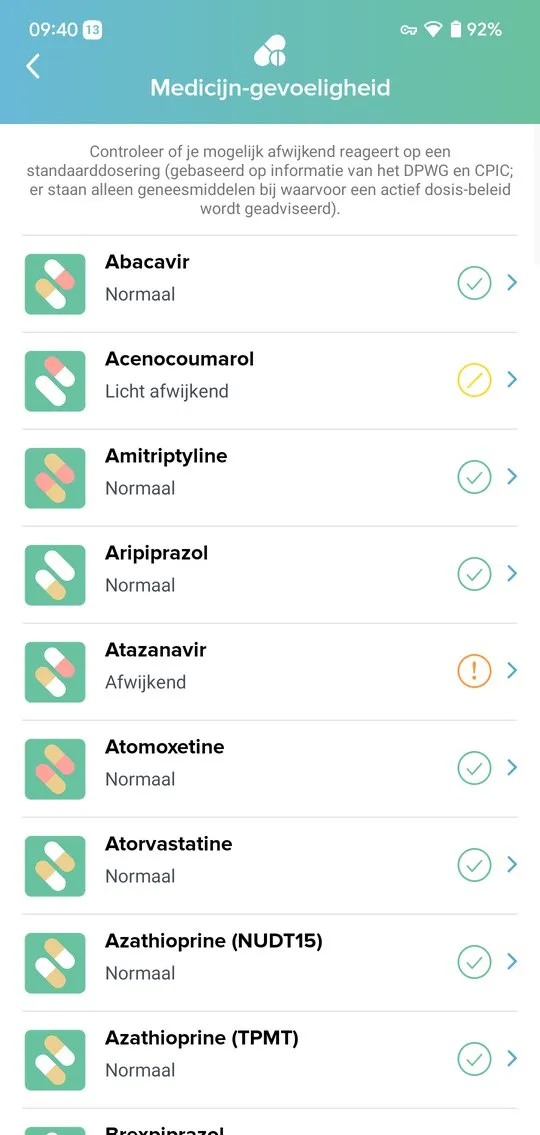
68 medicines in 12 groups.
Painkillers
Celecoxib
Celecoxib is a painkiller that is part of the group of medicines known as NSAIDs (non-steroidal anti-inflammatory drugs). Celecoxib not only relieves pain, but also has a fever-reducing and anti-inflammatory effect. Celecoxib is prescribed for, amongst other things, arthrosis (worn joints), rheumatoid arthritis, Bechterew’s disease, familial adenomatous polyposis and menstrual pain.
What does your DNA say?
The rate at which celecoxib is processed within your body varies from one individual to another. This means that the efficacy and side effects of celecoxib can be predicted to some extent on the basis of your genes.
What can you do with your result?
You know whether an official adjusted recommendation applies to you for celecoxib, such as a different dose or a different medicine. This allows your doctor or pharmacist to choose the right medicine at the right dose from the very first prescription.
Only medicines for which an active dosing recommendation currently applies. Never change your medication yourself: your doctor decides on the final course of treatment.
Painkillers
Codeine
Codeine is a morphine-like painkiller forming part of the class of medicines known as opioid analgesics. Codeine is usually used in combination with other painkillers. Besides acting as a painkiller, codeine also has cough-relieving properties. It is prescribed to treat tickly coughs and moderate to severe pain, sometimes in combination with the painkiller paracetamol.
What does your DNA say?
The rate at which codeine is processed within your body varies from one individual to another. This means that the efficacy and side effects of codeine can be predicted to some extent on the basis of your genes.
What can you do with your result?
You know whether an official adjusted recommendation applies to you for codeine, such as a different dose or a different medicine. This allows your doctor or pharmacist to choose the right medicine at the right dose from the very first prescription.
Only medicines for which an active dosing recommendation currently applies. Never change your medication yourself: your doctor decides on the final course of treatment.
Painkillers
Flurbiprofen
Flurbiprofen is a painkiller that is part of the group of medicines known as NSAIDs (non-steroidal anti-inflammatory drugs). Flurbiprofen not only relieves pain, but also has a fever-reducing and anti-inflammatory effect. Flurbiprofen is prescribed for the treatment of a sore throat (in the form of a lozenge or throat spray).
What does your DNA say?
The rate at which flurbiprofen is processed within your body varies from one individual to another. This means that the efficacy and side effects of flurbiprofen can be predicted to some extent on the basis of your genes.
What can you do with your result?
You know whether an official adjusted recommendation applies to you for flurbiprofen, such as a different dose or a different medicine. This allows your doctor or pharmacist to choose the right medicine at the right dose from the very first prescription.
Only medicines for which an active dosing recommendation currently applies. Never change your medication yourself: your doctor decides on the final course of treatment.
Painkillers
Ibuprofen
Ibuprofen is a painkiller that is part of the group of medicines known as NSAIDs (non-steroidal anti-inflammatory drugs). Ibuprofen not only relieves pain, but also has a fever-reducing and anti-inflammatory effect. Ibuprofen is prescribed for, amongst other things, headaches, migraines, arthrosis, muscle pain, menstrual complaints and flu. It is also prescribed to treat joint inflammation, such as gout, rheumatism or Bechterew’s disease.
What does your DNA say?
The rate at which ibuprofen is processed within your body varies from one individual to another. This means that the efficacy and side effects of ibuprofen can be predicted to some extent on the basis of your genes.
What can you do with your result?
You know whether an official adjusted recommendation applies to you for ibuprofen, such as a different dose or a different medicine. This allows your doctor or pharmacist to choose the right medicine at the right dose from the very first prescription.
Only medicines for which an active dosing recommendation currently applies. Never change your medication yourself: your doctor decides on the final course of treatment.
Painkillers
Lornoxicam
Lornoxicam is a painkiller that is part of the group of medicines known as NSAIDs (non-steroidal anti-inflammatory drugs). Lornoxicam not only relieves pain, but also has a fever-reducing and anti-inflammatory effect. Lornoxicam is prescribed for, amongst other things, arthrosis (worn joints), sciatica, rheumatoid arthritis and other inflammatory diseases.
What does your DNA say?
The rate at which lornoxicam is processed within your body varies from one individual to another. This means that the efficacy and side effects of lornoxicam can be predicted to some extent on the basis of your genes.
What can you do with your result?
You know whether an official adjusted recommendation applies to you for lornoxicam, such as a different dose or a different medicine. This allows your doctor or pharmacist to choose the right medicine at the right dose from the very first prescription.
Only medicines for which an active dosing recommendation currently applies. Never change your medication yourself: your doctor decides on the final course of treatment.
Painkillers
Meloxicam
Meloxicam is a painkiller that is part of the group of medicines known as NSAIDs (non-steroidal anti-inflammatory drugs). Meloxicam not only relieves pain, but also has a fever-reducing and anti-inflammatory effect. Meloxicam is prescribed for, amongst other things, arthrosis (worn joints), rheumatoid arthritis and Bechterew’s disease.
What does your DNA say?
The rate at which meloxicam is processed within your body varies from one individual to another. This means that the efficacy and side effects of meloxicam can be predicted to some extent on the basis of your genes.
What can you do with your result?
You know whether an official adjusted recommendation applies to you for meloxicam, such as a different dose or a different medicine. This allows your doctor or pharmacist to choose the right medicine at the right dose from the very first prescription.
Only medicines for which an active dosing recommendation currently applies. Never change your medication yourself: your doctor decides on the final course of treatment.
Painkillers
Piroxicam
Piroxicam is a painkiller that is part of the group of medicines known as NSAIDs (non-steroidal anti-inflammatory drugs). Piroxicam not only relieves pain, but also has a fever-reducing and anti-inflammatory effect. Piroxicam is prescribed for, amongst other things, arthrosis (worn joints), rheumatoid arthritis and Bechterew’s disease.
What does your DNA say?
The rate at which piroxicam is processed within your body varies from one individual to another. This means that the efficacy and side effects of piroxicam can be predicted to some extent on the basis of your genes.
What can you do with your result?
You know whether an official adjusted recommendation applies to you for piroxicam, such as a different dose or a different medicine. This allows your doctor or pharmacist to choose the right medicine at the right dose from the very first prescription.
Only medicines for which an active dosing recommendation currently applies. Never change your medication yourself: your doctor decides on the final course of treatment.
Painkillers
Tenoxicam
Tenoxicam is a painkiller that is part of the group of medicines known as NSAIDs (non-steroidal anti-inflammatory drugs). Tenoxicam not only relieves pain, but also has a fever-reducing and anti-inflammatory effect. Tenoxicam is prescribed for, amongst other things, tendinitis (inflammation of a tendon), bursitis, arthrosis (worn joints), rheumatoid arthritis and Bechterew’s disease.
What does your DNA say?
The rate at which tenoxicam is processed within your body varies from one individual to another. This means that the efficacy and side effects of tenoxicam can be predicted to some extent on the basis of your genes.
What can you do with your result?
You know whether an official adjusted recommendation applies to you for tenoxicam, such as a different dose or a different medicine. This allows your doctor or pharmacist to choose the right medicine at the right dose from the very first prescription.
Only medicines for which an active dosing recommendation currently applies. Never change your medication yourself: your doctor decides on the final course of treatment.
Painkillers
Tramadol
Tramadol is a morphine-like painkiller forming part of the class of medicines known as opioid analgesics. It is a moderate to strong painkiller that acts in the central nervous system within the spinal cord and brain. Tramadol is prescribed to treat severe sudden or long-term pain, such as pain resulting from serious injury, surgery or cancer, as well as to treat neuralgia and joint pain caused by arthrosis. It can also help to treat premature ejaculation.
What does your DNA say?
The rate at which tramadol is processed within your body varies from one individual to another. This means that the efficacy and side effects of tramadol can be predicted to some extent on the basis of your genes.
What can you do with your result?
You know whether an official adjusted recommendation applies to you for tramadol, such as a different dose or a different medicine. This allows your doctor or pharmacist to choose the right medicine at the right dose from the very first prescription.
Only medicines for which an active dosing recommendation currently applies. Never change your medication yourself: your doctor decides on the final course of treatment.
Antidepressants
Amitriptyline
Amitriptyline is an antidepressant forming part of the class of medicines known as tricyclic antidepressants (TCAs). TCAs inhibit the reuptake of the neurotransmitters serotonin and noradrenaline in the brain. They are older, but effective, medicines that are less selective than more modern reuptake inhibitors, such as SSRIs. Amitriptyline is prescribed to treat depression, anxiety disorders, neuralgia, bedwetting, muscle pain caused by fibromyalgia, migraines, persistent hiccups and hypersalivation.
What does your DNA say?
The rate at which amitriptyline is processed within your body varies from one individual to another. This means that the efficacy and side effects of amitriptyline can be predicted to some extent on the basis of your genes.
What can you do with your result?
You know whether an official adjusted recommendation applies to you for amitriptyline, such as a different dose or a different medicine. This allows your doctor or pharmacist to choose the right medicine at the right dose from the very first prescription.
Only medicines for which an active dosing recommendation currently applies. Never change your medication yourself: your doctor decides on the final course of treatment.
Antidepressants
Citalopram
Citalopram is an antidepressant forming part of the class of medicines known as selective serotonin reuptake inhibitors (SSRIs). It inhibits the reuptake of the neurotransmitter serotonin in the brain. Citalopram improves the mood and reduces anxiety, and is used to treat depression, anxiety disorders and premature ejaculation.
What does your DNA say?
The rate at which citalopram is processed within your body varies from one individual to another. This means that the efficacy and side effects of citalopram can be predicted to some extent on the basis of your genes.
What can you do with your result?
You know whether an official adjusted recommendation applies to you for citalopram, such as a different dose or a different medicine. This allows your doctor or pharmacist to choose the right medicine at the right dose from the very first prescription.
Only medicines for which an active dosing recommendation currently applies. Never change your medication yourself: your doctor decides on the final course of treatment.
Antidepressants
Clomipramine
Clomipramine is an antidepressant forming part of the class of medicines known as tricyclic antidepressants (TCAs). TCAs inhibit the reuptake of the neurotransmitters serotonin and noradrenaline in the brain. They are older, but effective, medicines that are less selective than more modern reuptake inhibitors, such as SSRIs. Clomipramine is prescribed to treat depression, anxiety disorders and narcolepsy (uncontrollable sleep attacks).
What does your DNA say?
The rate at which clomipramine is processed within your body varies from one individual to another. This means that the efficacy and side effects of clomipramine can be predicted to some extent on the basis of your genes.
What can you do with your result?
You know whether an official adjusted recommendation applies to you for clomipramine, such as a different dose or a different medicine. This allows your doctor or pharmacist to choose the right medicine at the right dose from the very first prescription.
Only medicines for which an active dosing recommendation currently applies. Never change your medication yourself: your doctor decides on the final course of treatment.
Antidepressants
Doxepin
Doxepin is an antidepressant forming part of the class of medicines known as tricyclic antidepressants (TCAs). TCAs inhibit the reuptake of the neurotransmitters serotonin and noradrenaline in the brain. They are older, but effective, medicines that are less selective than more modern reuptake inhibitors, such as SSRIs. Doxepin is prescribed to treat depression.
What does your DNA say?
The rate at which doxepin is processed within your body varies from one individual to another. This means that the efficacy and side effects of doxepin can be predicted to some extent on the basis of your genes.
What can you do with your result?
You know whether an official adjusted recommendation applies to you for doxepin, such as a different dose or a different medicine. This allows your doctor or pharmacist to choose the right medicine at the right dose from the very first prescription.
Only medicines for which an active dosing recommendation currently applies. Never change your medication yourself: your doctor decides on the final course of treatment.
Antidepressants
Escitalopram
Escitalopram is an antidepressant forming part of the class of medicines known as selective serotonin reuptake inhibitors (SSRIs). It inhibits the reuptake of the neurotransmitter serotonin in the brain. Escitalopram improves the mood and reduces anxiety. It is used to treat depression and anxiety disorders (such as obsessive-compulsive disorders, panic disorders, post-traumatic stress disorder and social anxiety disorder).
What does your DNA say?
The rate at which escitalopram is processed within your body varies from one individual to another. This means that the efficacy and side effects of escitalopram can be predicted to some extent on the basis of your genes.
What can you do with your result?
You know whether an official adjusted recommendation applies to you for escitalopram, such as a different dose or a different medicine. This allows your doctor or pharmacist to choose the right medicine at the right dose from the very first prescription.
Only medicines for which an active dosing recommendation currently applies. Never change your medication yourself: your doctor decides on the final course of treatment.
Antidepressants
Imipramine
Imipramine is an antidepressant forming part of the class of medicines known as tricyclic antidepressants (TCAs). TCAs inhibit the reuptake of the neurotransmitters serotonin and noradrenaline in the brain. They are older, but effective, medicines that are less selective than more modern reuptake inhibitors, such as SSRIs. Imipramine is prescribed to treat depression, anxiety disorders, neuralgia and narcolepsy (uncontrollable sleep attacks).
What does your DNA say?
The rate at which imipramine is processed within your body varies from one individual to another. This means that the efficacy and side effects of imipramine can be predicted to some extent on the basis of your genes.
What can you do with your result?
You know whether an official adjusted recommendation applies to you for imipramine, such as a different dose or a different medicine. This allows your doctor or pharmacist to choose the right medicine at the right dose from the very first prescription.
Only medicines for which an active dosing recommendation currently applies. Never change your medication yourself: your doctor decides on the final course of treatment.
Antidepressants
Nortriptyline
Nortriptyline is an antidepressant forming part of the class of medicines known as tricyclic antidepressants (TCAs). TCAs inhibit the reuptake of the neurotransmitters serotonin and noradrenaline in the brain. They are older, but effective, medicines that are less selective than more modern reuptake inhibitors, such as SSRIs. Nortriptyline is prescribed to treat depression and neuralgia, as well as to aid smoking cessation.
What does your DNA say?
The rate at which nortriptyline is processed within your body varies from one individual to another. This means that the efficacy and side effects of nortriptyline can be predicted to some extent on the basis of your genes.
What can you do with your result?
You know whether an official adjusted recommendation applies to you for nortriptyline, such as a different dose or a different medicine. This allows your doctor or pharmacist to choose the right medicine at the right dose from the very first prescription.
Only medicines for which an active dosing recommendation currently applies. Never change your medication yourself: your doctor decides on the final course of treatment.
Antidepressants
Paroxetine
Paroxetine is an antidepressant forming part of the class of medicines known as selective serotonin reuptake inhibitors (SSRIs). It inhibits the reuptake of the neurotransmitter serotonin in the brain. Paroxetine improves the mood and reduces anxiety, and is used to treat depression, anxiety disorders, neuralgia, certain types of itch, premature ejaculation and hot flushes during the menopause.
What does your DNA say?
The rate at which paroxetine is processed within your body varies from one individual to another. This means that the efficacy and side effects of paroxetine can be predicted to some extent on the basis of your genes.
What can you do with your result?
You know whether an official adjusted recommendation applies to you for paroxetine, such as a different dose or a different medicine. This allows your doctor or pharmacist to choose the right medicine at the right dose from the very first prescription.
Only medicines for which an active dosing recommendation currently applies. Never change your medication yourself: your doctor decides on the final course of treatment.
Antidepressants
Sertraline
Sertraline is an antidepressant forming part of the class of medicines known as selective serotonin reuptake inhibitors (SSRIs). It inhibits the reuptake of the neurotransmitter serotonin in the brain. Sertraline improves the mood and reduces anxiety, and is used to treat depression, anxiety disorders, neuralgia, premenstrual syndrome, certain types of itch, hiccups and premature ejaculation.
What does your DNA say?
The rate at which sertraline is processed within your body varies from one individual to another. This means that the efficacy and side effects of sertraline can be predicted to some extent on the basis of your genes.
What can you do with your result?
You know whether an official adjusted recommendation applies to you for sertraline, such as a different dose or a different medicine. This allows your doctor or pharmacist to choose the right medicine at the right dose from the very first prescription.
Only medicines for which an active dosing recommendation currently applies. Never change your medication yourself: your doctor decides on the final course of treatment.
Antidepressants
Venlafaxine
Venlafaxine is an antidepressant forming part of the class of medicines known as serotonin-noradrenaline reuptake inhibitors (SNRIs). SNRIs inhibit the reuptake of the neurotransmitters serotonin and noradrenaline in the brain. They are closely related to SSRIs, although the latter only inhibit the reuptake of serotonin. Venlafaxine is prescribed to treat depression, anxiety disorders, neuralgia and hot flushes during the menopause.
What does your DNA say?
The rate at which venlafaxine is processed within your body varies from one individual to another. This means that the efficacy and side effects of venlafaxine can be predicted to some extent on the basis of your genes.
What can you do with your result?
You know whether an official adjusted recommendation applies to you for venlafaxine, such as a different dose or a different medicine. This allows your doctor or pharmacist to choose the right medicine at the right dose from the very first prescription.
Only medicines for which an active dosing recommendation currently applies. Never change your medication yourself: your doctor decides on the final course of treatment.
Heart & blood vessels
Acenocoumarol
Acenocoumarol is a coumarin-like anticoagulant forming part of the class of medicines known as vitamin K antagonists. These medicines make it more difficult for blood to clump together, reducing the risk of thrombosis. Acenocoumarol is prescribed following a heart attack, stroke or TIA, as well as to treat thrombosis and cardiac arrhythmia.
What does your DNA say?
The rate at which acenocoumarol is processed within your body varies from one individual to another. This means that the efficacy and side effects of acenocoumarol can be predicted to some extent on the basis of your genes.
What can you do with your result?
You know whether an official adjusted recommendation applies to you for acenocoumarol, such as a different dose or a different medicine. This allows your doctor or pharmacist to choose the right medicine at the right dose from the very first prescription.
Only medicines for which an active dosing recommendation currently applies. Never change your medication yourself: your doctor decides on the final course of treatment.
Heart & blood vessels
Atorvastatin
Atorvastatin is a cholesterol synthesis inhibitor forming part of the statin family. Atorvastatin lowers cholesterol and reduces hardening of the arteries. It is used to treat a high cholesterol level in the blood and cardiovascular diseases. The medicine is also prescribed to treat conditions associated with an increased risk of cardiovascular diseases, such as diabetes or high blood pressure.
What does your DNA say?
The rate at which atorvastatin is processed within your body varies from one individual to another. This means that the efficacy and side effects of atorvastatin can be predicted to some extent on the basis of your genes.
What can you do with your result?
You know whether an official adjusted recommendation applies to you for atorvastatin, such as a different dose or a different medicine. This allows your doctor or pharmacist to choose the right medicine at the right dose from the very first prescription.
Only medicines for which an active dosing recommendation currently applies. Never change your medication yourself: your doctor decides on the final course of treatment.
Heart & blood vessels
Clopidogrel
Clopidogrel is an anticoagulant forming part of the class of medicines known as platelet aggregation inhibitors. These medicines make it more difficult for platelets to clump together, reducing the risk of blood clots developing (thrombosis). Clopidogrel is prescribed following a heart attack or stroke or to treat angina (heart spasm), but also after an angioplasty procedure or the insertion of a stent.
What does your DNA say?
The rate at which clopidogrel is activated within your body into an active component varies from one individual to another. This means that the efficacy and side effects of clopidogrel can be predicted to some extent on the basis of your genes.
What can you do with your result?
You know whether an official adjusted recommendation applies to you for clopidogrel, such as a different dose or a different medicine. This allows your doctor or pharmacist to choose the right medicine at the right dose from the very first prescription.
Only medicines for which an active dosing recommendation currently applies. Never change your medication yourself: your doctor decides on the final course of treatment.
Heart & blood vessels
Phenprocoumon
Phenprocoumon is a coumarin-like anticoagulant forming part of the class of medicines known as vitamin K antagonists. These medicines make it more difficult for blood to clump together, reducing the risk of thrombosis. Phenprocoumon is prescribed following a heart attack, stroke or TIA, as well as to treat thrombosis and cardiac arrhythmia.
What does your DNA say?
The rate at which phenprocoumon is processed within your body varies from one individual to another. This means that the efficacy and side effects of phenprocoumon can be predicted to some extent on the basis of your genes.
What can you do with your result?
You know whether an official adjusted recommendation applies to you for phenprocoumon, such as a different dose or a different medicine. This allows your doctor or pharmacist to choose the right medicine at the right dose from the very first prescription.
Only medicines for which an active dosing recommendation currently applies. Never change your medication yourself: your doctor decides on the final course of treatment.
Heart & blood vessels
Flecainide
Flecainide is an antiarrhythmic medicine forming part of the class of medicines known as class 1C antiarrhythmics (sodium channel blockers). Flecainide decreases and regulates the heart rate by slowing the conduction of impulses through the nerves and decreasing the excitability of the heart muscle. It is prescribed to treat cardiac arrhythmia (such as atrial fibrillation) as well as to prevent arrhythmias.
What does your DNA say?
The rate at which flecainide is processed within your body varies from one individual to another. This means that the efficacy and side effects of flecainide can be predicted to some extent on the basis of your genes.
What can you do with your result?
You know whether an official adjusted recommendation applies to you for flecainide, such as a different dose or a different medicine. This allows your doctor or pharmacist to choose the right medicine at the right dose from the very first prescription.
Only medicines for which an active dosing recommendation currently applies. Never change your medication yourself: your doctor decides on the final course of treatment.
Heart & blood vessels
Mavacamten
Mavacamten is a cardiac myosin inhibitor: a medicine that reduces the heart muscle’s ability to contract.
It is used to treat hypertrophic obstructive cardiomyopathy (HOCM). In this condition, the heart muscle is thickened (usually the wall between the ventricles), which can obstruct the flow of blood.
What does your DNA say?
The rate at which mavacamten is processed within your body varies from one individual to another. This means that the efficacy and side effects of mavacamten can be predicted to some extent on the basis of your genes.
What can you do with your result?
You know whether an official adjusted recommendation applies to you for mavacamten, such as a different dose or a different medicine. This allows your doctor or pharmacist to choose the right medicine at the right dose from the very first prescription.
Only medicines for which an active dosing recommendation currently applies. Never change your medication yourself: your doctor decides on the final course of treatment.
Heart & blood vessels
Metoprolol
Metoprolol is a commonly used medicine forming part of the class of medicines known as selective beta1 (β1) receptor blockers. Beta blockers have a positive effect on blood circulation and blood pressure, amongst other things. Metoprolol also slows the heart rate and reduces the amount of oxygen needed by the heart. It is used to treat angina (heart spasm resulting from oxygen deficiency), in the event of heart failure and after a cardiac arrest, and is also prescribed for cardiac arrhythmia, high blood pressure, migraines and an overactive thyroid.
What does your DNA say?
The rate at which metoprolol is processed within your body varies from one individual to another. This means that the efficacy and side effects of metoprolol can be predicted to some extent on the basis of your genes.
What can you do with your result?
You know whether an official adjusted recommendation applies to you for metoprolol, such as a different dose or a different medicine. This allows your doctor or pharmacist to choose the right medicine at the right dose from the very first prescription.
Only medicines for which an active dosing recommendation currently applies. Never change your medication yourself: your doctor decides on the final course of treatment.
Heart & blood vessels
Propafenone
Propafenone is an antiarrhythmic medicine forming part of the class of medicines known as class 1C antiarrhythmics (sodium channel blockers). Propafenone decreases and regulates the heart rate by slowing the conduction of impulses through the nerves and decreasing the excitability of the heart muscle. It is prescribed to treat cardiac arrhythmia (such as atrial fibrillation) as well as to prevent arrhythmias.
What does your DNA say?
The rate at which propafenone is processed within your body varies from one individual to another. This means that the efficacy and side effects of propafenone can be predicted to some extent on the basis of your genes.
What can you do with your result?
You know whether an official adjusted recommendation applies to you for propafenone, such as a different dose or a different medicine. This allows your doctor or pharmacist to choose the right medicine at the right dose from the very first prescription.
Only medicines for which an active dosing recommendation currently applies. Never change your medication yourself: your doctor decides on the final course of treatment.
Heart & blood vessels
Rosuvastatin
Rosuvastatin is a cholesterol synthesis inhibitor forming part of the statin family. Rosuvastatin lowers cholesterol and reduces hardening of the arteries. It is used to treat a high cholesterol level in the blood and cardiovascular diseases. The medicine is also prescribed to treat conditions associated with an increased risk of cardiovascular diseases, such as diabetes or high blood pressure.
What does your DNA say?
The rate at which rosuvastatin is processed within your body varies from one individual to another. This means that the efficacy and side effects of rosuvastatin can be predicted to some extent on the basis of your genes.
What can you do with your result?
You know whether an official adjusted recommendation applies to you for rosuvastatin, such as a different dose or a different medicine. This allows your doctor or pharmacist to choose the right medicine at the right dose from the very first prescription.
Only medicines for which an active dosing recommendation currently applies. Never change your medication yourself: your doctor decides on the final course of treatment.
Heart & blood vessels
Simvastatin
Simvastatin is a cholesterol synthesis inhibitor forming part of the statin family. Simvastatin lowers cholesterol and reduces hardening of the arteries. It is used to treat a high cholesterol level in the blood and cardiovascular diseases. The medicine is also prescribed to treat conditions associated with an increased risk of cardiovascular diseases, such as diabetes or high blood pressure.
What does your DNA say?
The rate at which simvastatin is processed within your body varies from one individual to another. This means that the efficacy and side effects of simvastatin can be predicted to some extent on the basis of your genes.
What can you do with your result?
You know whether an official adjusted recommendation applies to you for simvastatin, such as a different dose or a different medicine. This allows your doctor or pharmacist to choose the right medicine at the right dose from the very first prescription.
Only medicines for which an active dosing recommendation currently applies. Never change your medication yourself: your doctor decides on the final course of treatment.
Heart & blood vessels
Warfarin
Warfarin is a coumarin-like anticoagulant forming part of the class of medicines known as vitamin K antagonists. These medicines make it more difficult for blood to clump together, reducing the risk of thrombosis. Warfarin is prescribed following a heart attack, stroke or TIA, as well as to treat thrombosis and cardiac arrhythmia.
What does your DNA say?
The rate at which warfarin is processed within your body varies from one individual to another. This means that the efficacy and side effects of warfarin can be predicted to some extent on the basis of your genes.
What can you do with your result?
You know whether an official adjusted recommendation applies to you for warfarin, such as a different dose or a different medicine. This allows your doctor or pharmacist to choose the right medicine at the right dose from the very first prescription.
Only medicines for which an active dosing recommendation currently applies. Never change your medication yourself: your doctor decides on the final course of treatment.
Stomach acid reducers
Lansoprazole
Lansoprazole is a stomach acid reducer forming part of the class of medicines known as proton pump inhibitors. It decreases the amount of acid produced in the stomach. Lansoprazole is not only used to treat heartburn, but also gastric and duodenal ulcers. It is also used to prevent stomach problems if you are taking medicines that can damage your stomach.
What does your DNA say?
The rate at which lansoprazole is processed within your body varies from one individual to another. This means that the efficacy and side effects of lansoprazole can be predicted to some extent on the basis of your genes.
What can you do with your result?
You know whether an official adjusted recommendation applies to you for lansoprazole, such as a different dose or a different medicine. This allows your doctor or pharmacist to choose the right medicine at the right dose from the very first prescription.
Only medicines for which an active dosing recommendation currently applies. Never change your medication yourself: your doctor decides on the final course of treatment.
Stomach acid reducers
Omeprazole
Omeprazole is a stomach acid reducer forming part of the class of medicines known as proton pump inhibitors. It decreases the amount of acid produced in the stomach. Omeprazole is not only used to treat heartburn, but also gastric and duodenal ulcers. It is also used to prevent stomach problems if you are taking medicines that can damage your stomach.
What does your DNA say?
The rate at which omeprazole is processed within your body varies from one individual to another. This means that the efficacy and side effects of omeprazole can be predicted to some extent on the basis of your genes.
What can you do with your result?
You know whether an official adjusted recommendation applies to you for omeprazole, such as a different dose or a different medicine. This allows your doctor or pharmacist to choose the right medicine at the right dose from the very first prescription.
Only medicines for which an active dosing recommendation currently applies. Never change your medication yourself: your doctor decides on the final course of treatment.
Stomach acid reducers
Pantoprazole
Pantoprazole is a stomach acid reducer forming part of the class of medicines known as proton pump inhibitors. It decreases the amount of acid produced in the stomach. Pantoprazole is not only used to treat heartburn, but also gastric and duodenal ulcers. It is also used to prevent stomach problems if you are taking medicines that can damage your stomach.
What does your DNA say?
The rate at which pantoprazole is processed within your body varies from one individual to another. This means that the efficacy and side effects of pantoprazole can be predicted to some extent on the basis of your genes.
What can you do with your result?
You know whether an official adjusted recommendation applies to you for pantoprazole, such as a different dose or a different medicine. This allows your doctor or pharmacist to choose the right medicine at the right dose from the very first prescription.
Only medicines for which an active dosing recommendation currently applies. Never change your medication yourself: your doctor decides on the final course of treatment.
Antipsychotics
Aripiprazole
Aripiprazole is an antipsychotic forming part of the class of medicines known as atypical antipsychotics. This group of antipsychotics primarily works by reducing the effects of naturally occurring substances in the brain, such as dopamine and serotonin. Aripiprazole is prescribed to treat psychosis, schizophrenia, mania, depression, agitation and tics.
What does your DNA say?
The rate at which aripiprazole is processed within your body varies from one individual to another. This means that the efficacy and side effects of aripiprazole can be predicted to some extent on the basis of your genes.
What can you do with your result?
You know whether an official adjusted recommendation applies to you for aripiprazole, such as a different dose or a different medicine. This allows your doctor or pharmacist to choose the right medicine at the right dose from the very first prescription.
Only medicines for which an active dosing recommendation currently applies. Never change your medication yourself: your doctor decides on the final course of treatment.
Antipsychotics
Brexpiprazole
Brexpiprazole is an antipsychotic forming part of the class of medicines known as atypical antipsychotics. This group of antipsychotics primarily works by reducing the effects of naturally occurring substances in the brain, such as dopamine and serotonin. Brexpiprazole is prescribed to treat depression and schizophrenia.
What does your DNA say?
The rate at which brexpiprazole is processed within your body varies from one individual to another. This means that the efficacy and side effects of brexpiprazole can be predicted to some extent on the basis of your genes.
What can you do with your result?
You know whether an official adjusted recommendation applies to you for brexpiprazole, such as a different dose or a different medicine. This allows your doctor or pharmacist to choose the right medicine at the right dose from the very first prescription.
Only medicines for which an active dosing recommendation currently applies. Never change your medication yourself: your doctor decides on the final course of treatment.
Antipsychotics
Haloperidol
Haloperidol is a typical antipsychotic that is still frequently used. It inhibits the effects of dopamine, a naturally occurring substance, in the brain. Haloperidol is prescribed to treat psychosis, schizophrenia, mania, agitation, dementia, tics, obsessive-compulsive disorders, nausea and vomiting.
What does your DNA say?
The rate at which haloperidol is processed within your body varies from one individual to another. This means that the efficacy and side effects of haloperidol can be predicted to some extent on the basis of your genes.
What can you do with your result?
You know whether an official adjusted recommendation applies to you for haloperidol, such as a different dose or a different medicine. This allows your doctor or pharmacist to choose the right medicine at the right dose from the very first prescription.
Only medicines for which an active dosing recommendation currently applies. Never change your medication yourself: your doctor decides on the final course of treatment.
Antipsychotics
Pimozide
Pimozide is a typical antipsychotic that is still frequently used. It inhibits the effects of dopamine, a naturally occurring substance, in the brain. Pimozide is prescribed to treat psychosis, schizophrenia and tics.
What does your DNA say?
The rate at which pimozide is processed within your body varies from one individual to another. This means that the efficacy and side effects of pimozide can be predicted to some extent on the basis of your genes.
What can you do with your result?
You know whether an official adjusted recommendation applies to you for pimozide, such as a different dose or a different medicine. This allows your doctor or pharmacist to choose the right medicine at the right dose from the very first prescription.
Only medicines for which an active dosing recommendation currently applies. Never change your medication yourself: your doctor decides on the final course of treatment.
Antipsychotics
Quetiapine
Quetiapine is an antipsychotic forming part of the class of medicines known as atypical antipsychotics. This group of antipsychotics primarily works by reducing the effects of naturally occurring substances in the brain, such as dopamine and serotonin. Quetiapine is prescribed to treat psychosis, schizophrenia, mania, depression, agitation and tics.
What does your DNA say?
The rate at which quetiapine is processed within your body varies from one individual to another. This means that the efficacy and side effects of quetiapine can be predicted to some extent on the basis of your genes.
What can you do with your result?
You know whether an official adjusted recommendation applies to you for quetiapine, such as a different dose or a different medicine. This allows your doctor or pharmacist to choose the right medicine at the right dose from the very first prescription.
Only medicines for which an active dosing recommendation currently applies. Never change your medication yourself: your doctor decides on the final course of treatment.
Antipsychotics
Risperidone
Risperidone is an antipsychotic forming part of the class of medicines known as atypical antipsychotics. This group of antipsychotics primarily works by reducing the effects of naturally occurring substances in the brain, such as dopamine and serotonin. Risperidone is prescribed to treat psychosis, schizophrenia, mania, severe depression, dementia, agitation, tics, obsessive-compulsive disorders and post-traumatic stress disorder.
What does your DNA say?
The rate at which risperidone is processed within your body varies from one individual to another. This means that the efficacy and side effects of risperidone can be predicted to some extent on the basis of your genes.
What can you do with your result?
You know whether an official adjusted recommendation applies to you for risperidone, such as a different dose or a different medicine. This allows your doctor or pharmacist to choose the right medicine at the right dose from the very first prescription.
Only medicines for which an active dosing recommendation currently applies. Never change your medication yourself: your doctor decides on the final course of treatment.
Antipsychotics
Zuclopenthixol
Zuclopenthixol is a typical antipsychotic that is still frequently used. It inhibits the effects of dopamine, a naturally occurring substance, in the brain. Zuclopenthixol is prescribed to treat psychosis, schizophrenia, mania and agitation.
What does your DNA say?
The rate at which zuclopenthixol is processed within your body varies from one individual to another. This means that the efficacy and side effects of zuclopenthixol can be predicted to some extent on the basis of your genes.
What can you do with your result?
You know whether an official adjusted recommendation applies to you for zuclopenthixol, such as a different dose or a different medicine. This allows your doctor or pharmacist to choose the right medicine at the right dose from the very first prescription.
Only medicines for which an active dosing recommendation currently applies. Never change your medication yourself: your doctor decides on the final course of treatment.
Epilepsy
Carbamazepine
Carbamazepine is an anticonvulsant forming part of the class of medicines known as sodium channel blockers. It calms overstimulated nerves in the brain by influencing the transmission of information via the nerves. Carbamazepine is prescribed to treat epilepsy, manic depression, neuralgia, diabetes insipidus and alcohol withdrawal.
What does your DNA say?
The risk of side effects resulting from a treatment with carbamazepine varies from one individual to another. This means that the efficacy and side effects of carbamazepine can be predicted to some extent on the basis of your genes.
What can you do with your result?
You know whether an official adjusted recommendation applies to you for carbamazepine, such as a different dose or a different medicine. This allows your doctor or pharmacist to choose the right medicine at the right dose from the very first prescription.
Only medicines for which an active dosing recommendation currently applies. Never change your medication yourself: your doctor decides on the final course of treatment.
Epilepsy
Phenytoin
Phenytoin or diphenylhydantoin is both an anticonvulsant and an antiarrhythmic medicine forming part of the class of medicines known as class 1C antiarrhythmics (sodium channel blockers). Phenytoin calms overstimulated nerves in the brain and heart. It is prescribed to treat epilepsy and cardiac arrhythmia.
What does your DNA say?
The rate at which phenytoin is processed within your body varies from one individual to another. This means that the efficacy and side effects of phenytoin can be predicted to some extent on the basis of your genes.
What can you do with your result?
You know whether an official adjusted recommendation applies to you for phenytoin, such as a different dose or a different medicine. This allows your doctor or pharmacist to choose the right medicine at the right dose from the very first prescription.
Only medicines for which an active dosing recommendation currently applies. Never change your medication yourself: your doctor decides on the final course of treatment.
Epilepsy
Lamotrigine
Lamotrigine is an anticonvulsant forming part of the class of medicines known as sodium channel blockers. It calms overstimulated nerves in the brain by influencing the transmission of information via the nerves. Lamotrigine is prescribed to treat epilepsy, manic depression, neuralgia and post-traumatic stress disorder (PTSD).
What does your DNA say?
The risk of side effects resulting from a treatment with lamotrigine varies from one individual to another. This means that the efficacy and side effects of lamotrigine can be predicted to some extent on the basis of your genes.
What can you do with your result?
You know whether an official adjusted recommendation applies to you for lamotrigine, such as a different dose or a different medicine. This allows your doctor or pharmacist to choose the right medicine at the right dose from the very first prescription.
Only medicines for which an active dosing recommendation currently applies. Never change your medication yourself: your doctor decides on the final course of treatment.
Epilepsy
Oxcarbazepine
Oxcarbazepine is an anticonvulsant forming part of the class of medicines known as sodium channel blockers. It calms overstimulated nerves in the brain by influencing the transmission of information via the nerves. Oxcarbazepine is prescribed to treat epilepsy and neuralgia.
What does your DNA say?
The risk of side effects resulting from a treatment with oxcarbazepine varies from one individual to another. This means that the efficacy and side effects of oxcarbazepine can be predicted to some extent on the basis of your genes.
What can you do with your result?
You know whether an official adjusted recommendation applies to you for oxcarbazepine, such as a different dose or a different medicine. This allows your doctor or pharmacist to choose the right medicine at the right dose from the very first prescription.
Only medicines for which an active dosing recommendation currently applies. Never change your medication yourself: your doctor decides on the final course of treatment.
Cancer & immunity
Azathioprine
Azathioprine is an immunosuppressant: a medicine that suppresses the function of the immune system. It forms part of the thiopurine class of medicines. Azathioprine is prescribed to prevent rejection following organ transplants, as well as to treat inflammatory diseases (such as certain bowel diseases, rheumatoid arthritis, severe dermatitis and lupus erythematosus), hepatitis, the blood-clotting disorder ITP and serious forms of anaemia.
What does your DNA say?
The rate at which azathioprine is processed within your body varies from one individual to another. This means that the efficacy and side effects of azathioprine can be predicted to some extent on the basis of your genes.
What can you do with your result?
You know whether an official adjusted recommendation applies to you for azathioprine, such as a different dose or a different medicine. This allows your doctor or pharmacist to choose the right medicine at the right dose from the very first prescription.
Only medicines for which an active dosing recommendation currently applies. Never change your medication yourself: your doctor decides on the final course of treatment.
Cancer & immunity
Capecitabine
Capecitabine is a cytostatic: a medicine that inhibits cell growth and cell division. It is used to treat various types of cancer, such as breast cancer, stomach cancer and bowel cancer.
What does your DNA say?
The rate at which capecitabine is processed within your body varies from one individual to another. This means that the efficacy and side effects of capecitabine can be predicted to some extent on the basis of your genes.
What can you do with your result?
You know whether an official adjusted recommendation applies to you for capecitabine, such as a different dose or a different medicine. This allows your doctor or pharmacist to choose the right medicine at the right dose from the very first prescription.
Only medicines for which an active dosing recommendation currently applies. Never change your medication yourself: your doctor decides on the final course of treatment.
Cancer & immunity
Fluorouracil
Fluorouracil, also known as 5-FU, is a cytostatic: a medicine that inhibits cell growth and cell division. It is used to treat various types of cancer, such as cancer of the oesophagus, breast, stomach, bowel, pancreas, liver, bladder, uterus, ovaries, vagina, skin and brain. It is also used to treat superficial skin tumours and their precursors.
What does your DNA say?
The rate at which fluorouracil is processed within your body varies from one individual to another. This means that the efficacy and side effects of fluorouracil can be predicted to some extent on the basis of your genes.
What can you do with your result?
You know whether an official adjusted recommendation applies to you for fluorouracil, such as a different dose or a different medicine. This allows your doctor or pharmacist to choose the right medicine at the right dose from the very first prescription.
Only medicines for which an active dosing recommendation currently applies. Never change your medication yourself: your doctor decides on the final course of treatment.
Cancer & immunity
Gefitinib
Gefitinib is a so-called targeted cancer medicine. It inhibits the growth of rapidly dividing cells, especially in tumours that carry a specific change (mutation) in the EGFR gene. This mutation can be detected with a laboratory test. Other rapidly growing tissues, such as mucous membranes and skin, also rely on EGFR signals for normal cell growth. As a result, these tissues may also be inhibited, which can lead to side effects.
Gefitinib is used to treat certain types of non-small cell lung cancer. The medicine is particularly suitable when the tumour contains an EGFR mutation.
What does your DNA say?
The rate at which gefitinib is processed within your body varies from one individual to another. This means that the efficacy and side effects of gefitinib can be predicted to some extent on the basis of your genes.
What can you do with your result?
You know whether an official adjusted recommendation applies to you for gefitinib, such as a different dose or a different medicine. This allows your doctor or pharmacist to choose the right medicine at the right dose from the very first prescription.
Only medicines for which an active dosing recommendation currently applies. Never change your medication yourself: your doctor decides on the final course of treatment.
Cancer & immunity
Irinotecan
Irinotecan is a cytostatic: a medicine that inhibits cell growth and cell division. It also suppresses the function of the immune system, so that less inflammation occurs (immunosuppressant). Irinotecan is a topoisomerase inhibitor.
Irinotecan is prescribed to treat cancer of the large intestine and rectum, if the cancer has reached an advanced stage. It is also used to treat lung cancer and pancreatic cancer.
What does your DNA say?
The rate at which irinotecan is processed within your body varies from one individual to another. This means that the efficacy and side effects of irinotecan can be predicted to some extent on the basis of your genes.
What can you do with your result?
You know whether an official adjusted recommendation applies to you for irinotecan, such as a different dose or a different medicine. This allows your doctor or pharmacist to choose the right medicine at the right dose from the very first prescription.
Only medicines for which an active dosing recommendation currently applies. Never change your medication yourself: your doctor decides on the final course of treatment.
Cancer & immunity
Mercaptopurine
Mercaptopurine is a cytostatic: a medicine that inhibits cell growth and cell division. It also suppresses the function of the immune system, so that less inflammation occurs (immunosuppressant). Mercaptopurine forms part of the thiopurine class of medicines. It is prescribed to treat certain forms of blood cancer, such as leukaemia. It is also used to treat chronic bowel diseases, such as ulcerative colitis and Crohn’s disease.
What does your DNA say?
The rate at which mercaptopurine is processed within your body varies from one individual to another. This means that the efficacy and side effects of mercaptopurine can be predicted to some extent on the basis of your genes.
What can you do with your result?
You know whether an official adjusted recommendation applies to you for mercaptopurine, such as a different dose or a different medicine. This allows your doctor or pharmacist to choose the right medicine at the right dose from the very first prescription.
Only medicines for which an active dosing recommendation currently applies. Never change your medication yourself: your doctor decides on the final course of treatment.
Cancer & immunity
Sacituzumab govitecan
Sacituzumab govitecan is a so-called targeted cancer medicine. It consists of an antibody that attaches to certain cancer cells, combined with a powerful active substance. Thanks to this combination, the medicine mainly reaches the places where it is needed. Inside the cancer cell, the active substance can then disrupt cell growth and thereby enhance the effect of the treatment.
Sacituzumab govitecan is used for certain types of cancer, such as metastatic breast cancer and bladder cancer (urothelial carcinoma), when other treatments do not work well enough.
What does your DNA say?
The rate at which sacituzumab govitecan is processed within your body varies from one individual to another. This means that the efficacy and side effects of sacituzumab govitecan can be predicted to some extent on the basis of your genes.
What can you do with your result?
You know whether an official adjusted recommendation applies to you for sacituzumab govitecan, such as a different dose or a different medicine. This allows your doctor or pharmacist to choose the right medicine at the right dose from the very first prescription.
Only medicines for which an active dosing recommendation currently applies. Never change your medication yourself: your doctor decides on the final course of treatment.
Cancer & immunity
Siponimod
Siponimod is a medicine that suppresses the function of the immune system. It is a so-called selective sphingosine-1-phosphate receptor modulator.
Siponimod is prescribed to treat multiple sclerosis (MS), in particular for the treatment of adults with secondary progressive multiple sclerosis (both relapsing and non-relapsing).
What does your DNA say?
The rate at which siponimod is processed within your body varies from one individual to another. This means that the efficacy and side effects of siponimod can be predicted to some extent on the basis of your genes.
What can you do with your result?
You know whether an official adjusted recommendation applies to you for siponimod, such as a different dose or a different medicine. This allows your doctor or pharmacist to choose the right medicine at the right dose from the very first prescription.
Only medicines for which an active dosing recommendation currently applies. Never change your medication yourself: your doctor decides on the final course of treatment.
Cancer & immunity
Tacrolimus
Tacrolimus is an immunosuppressant: it suppresses the body’s own defences against foreign cells. Tacrolimus is used to prevent rejection following organ transplants.
What does your DNA say?
The rate at which tacrolimus is processed within your body varies from one individual to another. This means that the efficacy and side effects of tacrolimus can be predicted to some extent on the basis of your genes.
What can you do with your result?
You know whether an official adjusted recommendation applies to you for tacrolimus, such as a different dose or a different medicine. This allows your doctor or pharmacist to choose the right medicine at the right dose from the very first prescription.
Only medicines for which an active dosing recommendation currently applies. Never change your medication yourself: your doctor decides on the final course of treatment.
Cancer & immunity
Tegafur
Tegafur itself is an inactive medicine that is converted by the body into the active medicine fluorouracil. Fluorouracil is a cytostatic: it inhibits cell growth and cell division. Tegafur is used to treat advanced stomach cancer, usually in combination with gimeracil and oteracil. Gimeracil slows down the breakdown of fluorouracil, allowing it to work for longer. Oteracil reduces side effects.
What does your DNA say?
The rate at which tegafur is processed within your body varies from one individual to another. This means that the efficacy and side effects of tegafur can be predicted to some extent on the basis of your genes.
What can you do with your result?
You know whether an official adjusted recommendation applies to you for tegafur, such as a different dose or a different medicine. This allows your doctor or pharmacist to choose the right medicine at the right dose from the very first prescription.
Only medicines for which an active dosing recommendation currently applies. Never change your medication yourself: your doctor decides on the final course of treatment.
Cancer & immunity
Tioguanine
Tioguanine is a cytostatic: a medicine that inhibits cell growth and cell division. It also suppresses the function of the immune system, so that less inflammation occurs (immunosuppressant). Tioguanine forms part of the thiopurine class of medicines. It is prescribed to treat certain forms of blood cancer, such as leukaemia. It is also used to treat chronic bowel diseases, such as ulcerative colitis and Crohn’s disease.
What does your DNA say?
The rate at which tioguanine is processed within your body varies from one individual to another. This means that the efficacy and side effects of tioguanine can be predicted to some extent on the basis of your genes.
What can you do with your result?
You know whether an official adjusted recommendation applies to you for tioguanine, such as a different dose or a different medicine. This allows your doctor or pharmacist to choose the right medicine at the right dose from the very first prescription.
Only medicines for which an active dosing recommendation currently applies. Never change your medication yourself: your doctor decides on the final course of treatment.
Antivirals
Abacavir
Abacavir is a medicine that inhibits the growth of viruses. It is used to treat HIV infections and AIDS.
What does your DNA say?
In around 5% of all people, a treatment with abacavir triggers severe side effects, which are grouped under the heading of hypersensitivity reactions. These can be life-threatening. Hypersensitivity to abacavir can be predicted to some extent on the basis of your genes.
What can you do with your result?
You know whether an official adjusted recommendation applies to you for abacavir, such as a different dose or a different medicine. This allows your doctor or pharmacist to choose the right medicine at the right dose from the very first prescription.
Only medicines for which an active dosing recommendation currently applies. Never change your medication yourself: your doctor decides on the final course of treatment.
Antivirals
Atazanavir
Atazanavir is a medicine that inhibits the growth of viruses. It is used to treat HIV infections and AIDS. HIV treatments always involve a combination of several medicines.
What does your DNA say?
The use of atazanavir can lead to hyperbilirubinaemia (jaundice) in some cases. Jaundice is a yellow discolouration of the skin and/or the whites of the eyes, sometimes with itching.
The risk of side effects can be predicted to some extent on the basis of your genes.
What can you do with your result?
You know whether an official adjusted recommendation applies to you for atazanavir, such as a different dose or a different medicine. This allows your doctor or pharmacist to choose the right medicine at the right dose from the very first prescription.
Only medicines for which an active dosing recommendation currently applies. Never change your medication yourself: your doctor decides on the final course of treatment.
Antivirals
Efavirenz
Efavirenz is a medicine that inhibits the growth of viruses. It is used to treat HIV infections and AIDS. HIV treatments always involve a combination of several medicines.
What does your DNA say?
Efavirenz normally has relatively mild side effects, such as rashes, nausea, vomiting, diarrhoea, dizziness, tiredness, headaches, anxiety and depression. In fewer than 1% of people, however, a treatment with efavirenz triggers severe side effects, which are grouped under the heading of hypersensitivity reactions. These can be life-threatening.
The risk of side effects can be predicted to some extent on the basis of your genes.
What can you do with your result?
You know whether an official adjusted recommendation applies to you for efavirenz, such as a different dose or a different medicine. This allows your doctor or pharmacist to choose the right medicine at the right dose from the very first prescription.
Only medicines for which an active dosing recommendation currently applies. Never change your medication yourself: your doctor decides on the final course of treatment.
Fungal infections
Flucytosine
Flucytosine is an antimycotic, or antifungal, medicine. It kills infection-causing fungi or inhibits their growth. It is also active against fungus-like yeasts, such as Candida. Flucytosine is used for serious yeast and fungal infections, such as meningitis caused by Cryptococci or serious Candida infections. It is usually used in combination with other antifungal medicines.
What does your DNA say?
The rate at which flucytosine is processed within your body varies from one individual to another. This means that the efficacy and side effects of flucytosine can be predicted to some extent on the basis of your genes.
What can you do with your result?
You know whether an official adjusted recommendation applies to you for flucytosine, such as a different dose or a different medicine. This allows your doctor or pharmacist to choose the right medicine at the right dose from the very first prescription.
Only medicines for which an active dosing recommendation currently applies. Never change your medication yourself: your doctor decides on the final course of treatment.
Fungal infections
Voriconazole
Voriconazole is an antimycotic, or antifungal, medicine. It kills infection-causing fungi or inhibits their growth. It is also active against fungus-like yeasts, such as Candida. Voriconazole is used to treat serious yeast and fungal infections, such as the lung infection aspergillosis or Candida infections.
What does your DNA say?
The rate at which voriconazole is processed within your body varies from one individual to another. This means that the efficacy and side effects of voriconazole can be predicted to some extent on the basis of your genes.
What can you do with your result?
You know whether an official adjusted recommendation applies to you for voriconazole, such as a different dose or a different medicine. This allows your doctor or pharmacist to choose the right medicine at the right dose from the very first prescription.
Only medicines for which an active dosing recommendation currently applies. Never change your medication yourself: your doctor decides on the final course of treatment.
Antibiotics
Flucloxacillin
Flucloxacillin is a narrow-spectrum antibiotic forming part of the penicillin class. It is used to treat infections caused by a particular group of (gram-positive) bacteria. Examples include skin infections, such as impetigo, boils, erysipelas, inflamed eczema and inflammation of the outer ear canal.
What does your DNA say?
In some cases there can be mild side effects, such as nausea, vomiting, diarrhoea and rashes, when flucloxacillin is taken. Usually, these are not serious and are temporary in nature. However, there is also a very small risk of severe side effects in the form of liver damage; this risk varies from one individual to another. It can be predicted to some extent on the basis of your genes.
What can you do with your result?
You know whether an official adjusted recommendation applies to you for flucloxacillin, such as a different dose or a different medicine. This allows your doctor or pharmacist to choose the right medicine at the right dose from the very first prescription.
Only medicines for which an active dosing recommendation currently applies. Never change your medication yourself: your doctor decides on the final course of treatment.
Muscle relaxants
Mivacurium
Mivacurium is a muscle relaxant used to relax the skeletal muscles, facilitate the insertion of a breathing tube and allow mechanical ventilation during surgery or other medical procedures.
What does your DNA say?
The rate at which mivacurium is processed within your body varies from one individual to another. This means that the efficacy and side effects of mivacurium can be predicted to some extent on the basis of your genes.
What can you do with your result?
You know whether an official adjusted recommendation applies to you for mivacurium, such as a different dose or a different medicine. This allows your doctor or pharmacist to choose the right medicine at the right dose from the very first prescription.
Only medicines for which an active dosing recommendation currently applies. Never change your medication yourself: your doctor decides on the final course of treatment.
Muscle relaxants
Succinylcholine
Succinylcholine is a muscle relaxant that relaxes almost all the muscles in the body, including the respiratory muscles. It is used during surgery or other medical procedures that require fast action, and in situations where a short duration of action is desirable.
What does your DNA say?
The rate at which succinylcholine is processed within your body varies from one individual to another. This means that the efficacy and side effects of succinylcholine can be predicted to some extent on the basis of your genes.
What can you do with your result?
You know whether an official adjusted recommendation applies to you for succinylcholine, such as a different dose or a different medicine. This allows your doctor or pharmacist to choose the right medicine at the right dose from the very first prescription.
Only medicines for which an active dosing recommendation currently applies. Never change your medication yourself: your doctor decides on the final course of treatment.
Other medicines
Allopurinol
Allopurinol is an enzyme inhibitor that reduces uric acid in the blood by inhibiting the conversion of purine to uric acid. When the concentration of uric acid in the blood is too high, crystals form in joints and kidneys. Lumps may also form in the skin. Allopurinol is used for gout, kidney stones, kidney diseases and certain metabolic diseases. It is also used in cancer, where large amounts of uric acid can be produced as a side effect of chemotherapy.
What does your DNA say?
The rate at which uric acid is excreted by your body varies from one individual to another. This means that the efficacy and side effects of allopurinol can be predicted to some extent on the basis of your genes.
What can you do with your result?
You know whether an official adjusted recommendation applies to you for allopurinol, such as a different dose or a different medicine. This allows your doctor or pharmacist to choose the right medicine at the right dose from the very first prescription.
Only medicines for which an active dosing recommendation currently applies. Never change your medication yourself: your doctor decides on the final course of treatment.
Other medicines
Atomoxetine
Atomoxetine is a very selective noradrenaline reuptake inhibitor. Atomoxetine regulates the amount of noradrenaline in the brain. Noradrenaline is a naturally occurring substance that plays a role in sustaining attention. Atomoxetine is therefore prescribed to treat ADHD (Attention Deficit Hyperactivity Disorder).
What does your DNA say?
The rate at which atomoxetine is processed within your body varies from one individual to another. This means that the efficacy and side effects of atomoxetine can be predicted to some extent on the basis of your genes.
What can you do with your result?
You know whether an official adjusted recommendation applies to you for atomoxetine, such as a different dose or a different medicine. This allows your doctor or pharmacist to choose the right medicine at the right dose from the very first prescription.
Only medicines for which an active dosing recommendation currently applies. Never change your medication yourself: your doctor decides on the final course of treatment.
Other medicines
Eliglustat
Eliglustat is a relatively new medicine used in the long-term treatment of patients with type I Gaucher disease. Gaucher disease is a rare, inherited metabolic disorder in which the enzyme glucocerebrosidase does not work correctly. This causes fatty substances to build up inside cells.
Eliglustat inhibits the formation of these fatty substances by influencing the function of another enzyme (glucosylceramide synthase).
What does your DNA say?
The rate at which eliglustat is processed within your body varies from one individual to another. This means that the efficacy and side effects of eliglustat can be predicted to some extent on the basis of your genes.
What can you do with your result?
You know whether an official adjusted recommendation applies to you for eliglustat, such as a different dose or a different medicine. This allows your doctor or pharmacist to choose the right medicine at the right dose from the very first prescription.
Only medicines for which an active dosing recommendation currently applies. Never change your medication yourself: your doctor decides on the final course of treatment.
Other medicines
Contraceptives that contain oestrogen
The most common contraceptives that contain oestrogen are so-called combined pills, which, besides preventing pregnancy, also aim to mimic a woman’s menstrual cycle as closely as possible. The monophasic pill contains a fixed dose of oestrogen and progestogen, while the multiphasic pills contain varying doses. The monophasic pill is the one most commonly prescribed.
Contraceptives that contain oestrogen normally increase the risk of thrombosis (blockage of a blood vessel by a blood clot). The absolute risk is relatively small; every year around 5 to 12 in every 10,000 women who take these contraceptives develop thrombosis.
What does your DNA say?
The risk of thrombosis when taking contraceptives that contain oestrogen varies from one individual to another. The risk of thrombosis increases if you have high blood pressure, smoke, are older or overweight, have poor circulation, have cardiac arrhythmia or have a hereditary abnormality.
If you have a hereditary abnormality, blood clotting is not inhibited as effectively as it should be, or levels of substances that stimulate clotting are too high. Two relatively common hereditary abnormalities are factor V Leiden and factor II.
What can you do with your result?
You know whether you have a hereditary abnormality that increases your risk of thrombosis. This allows you and your doctor to choose a contraceptive that suits you.
Only medicines for which an active dosing recommendation currently applies. Never change your medication yourself: your doctor decides on the final course of treatment.
Other medicines
Tamoxifen
Tamoxifen is a medicine forming part of the class of medicines known as selective oestrogen receptor modulators (SERMs). Tamoxifen has an anti-oestrogen effect and inhibits the growth of oestrogen-sensitive tumours. It also reduces swelling of the mammary glands in women and men. The medicine is prescribed for breast cancer, severe breast pain during menstruation and reduced fertility, and is also given to men who experience swelling of the breasts as a side effect of a medicine.
What does your DNA say?
The rate at which tamoxifen is processed within your body varies from one individual to another. This means that the efficacy and side effects of tamoxifen can be predicted to some extent on the basis of your genes.
What can you do with your result?
You know whether an official adjusted recommendation applies to you for tamoxifen, such as a different dose or a different medicine. This allows your doctor or pharmacist to choose the right medicine at the right dose from the very first prescription.
Only medicines for which an active dosing recommendation currently applies. Never change your medication yourself: your doctor decides on the final course of treatment.
How does it work?
1 Order your test
2 Spit into the tube
3 Create your code
4 Send it back
5 Results in your app
Your results in the app
Your results, clear and always at hand.
All medicines for which adjusted dosage advice may apply, clearly arranged on your phone or tablet. You can see straight away for which medicines you may need an adjusted dose. In the app you’ll find your Medication DNA Passport under “Drug sensitivity”. When new guidelines are published, we update it automatically. And via the app you can easily share your results with a healthcare professional, such as your GP or pharmacist.
RWR. Van Der Wal-SekkerTrustpilot · translated from Dutch
“Good to know what is and is not good when using medicines.”
SKSander KlarenbeekTrustpilot · translated from Dutch
“The process is clear: what is going to happen and what can I expect. The app is clear. The test is very extensive and helped me and the doctor find the right medication.”
MMeulmeesterTrustpilot · translated from Dutch
“Good, clear descriptions in understandable language. The medication passport is also very useful. Now treatment can be tailor-made instead of trying things out.”
Want to know which DNA test is right for you?
Answer 9 short questions online and get advice straight away.